Match Reports
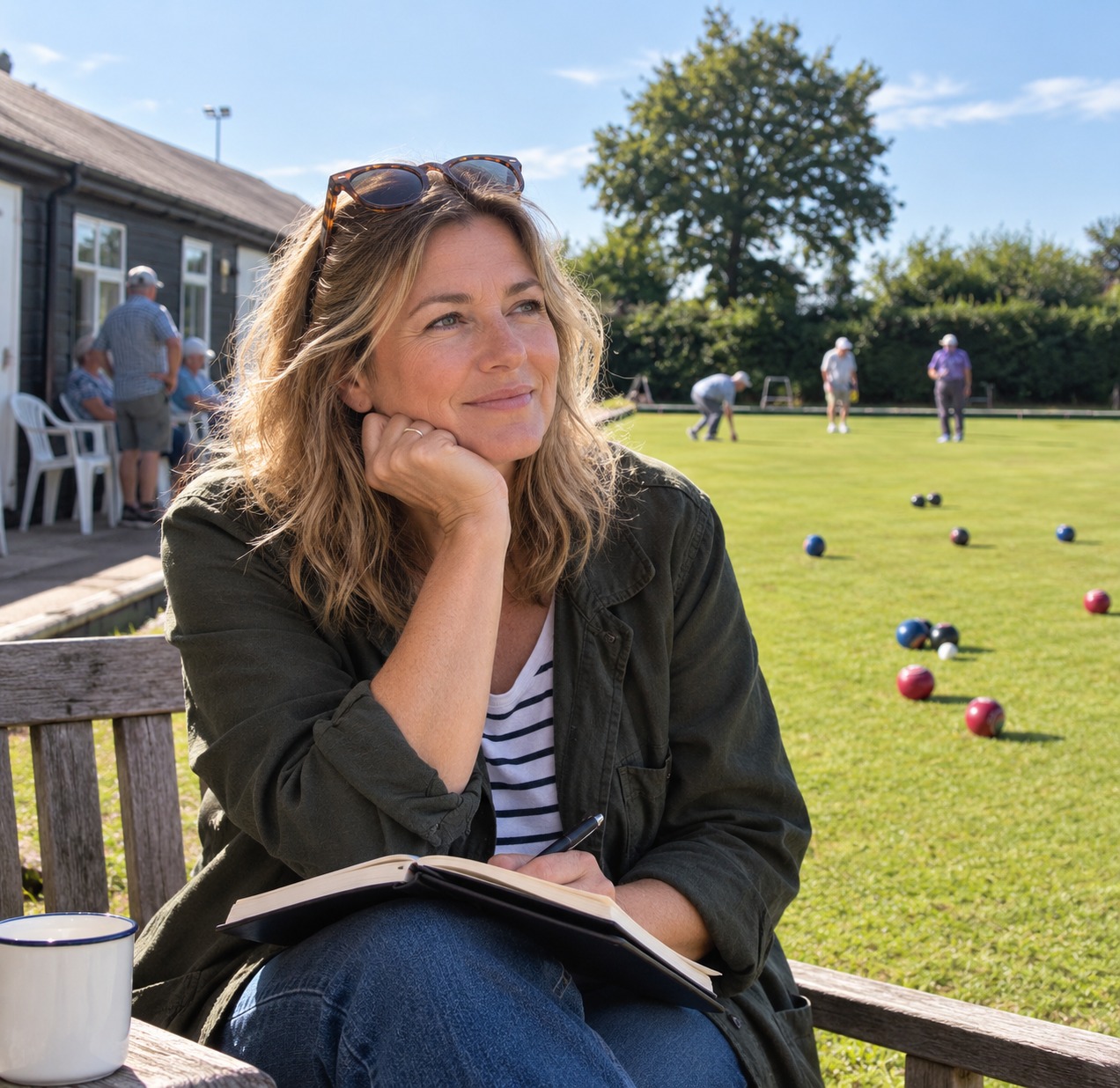


Sometimes the bowls takes a back seat.
And sometimes that back seat is in a Kia Sportage filled with bowlers and their bowls, desperately trying to make it up a Khyber-like dirt road in first gear, praying to the gods of the green that you don't start rolling backwards.
But by that same God, is it worth the door-rest-grabbing, heart-palpitating ascent?
Sutton Bowls Club, the setting for my first away game reporting on Billingshurst, could not have been a better way to take away my away-day flower.
Nestled up in the Downs, the location is stunning. And only got more so as the daylight started to slip away and the palette of oranges, yellows and reds began replacing the deep blue of the day, painting the sky above the lush green trees and hills.
There isn't much that can drag my eyes away from the green these days when there's bowls to watch, but the majesty of this view did.
But now... to the green.
With no irrigation system and surrounded by trees, it's a sight to behold, even if the word green needs to be stretched to its very limit.
The noobs among us (myself included) looked at the turf with apprehension, especially as club chairman Stuart was still picking up leaves. But I was reliably informed by everyone that the huge number of idiosyncrasies actually made for a much more intriguing challenge.
Little wibbles, changes of direction, going against bias, staying straight, bouncing up and over divots – all part of the game in Sutton. And a game Billingshurst rose to superbly.
In the car over, Barry said:
"We rarely ever win here."
It feels like Ben took that as a challenge and used it to fire another exemplary performance.
The match itself followed the same pattern as the green – unpredictable but gradually tipping Billingshurst's way. A slender early lead remained intact throughout before growing into a deserved 67–54 victory as the evening light began to fade. Lesley, Roger and Barry were narrowly beaten 15–13, as were Noel, Marion and Gary, who lost 17–15. Robin, Alan K. and Ben secured an impressive 17–15 win, while Top Rink honours deservedly went to Tessa, Alan R. and Ray N., whose outstanding 22–7 victory helped seal an excellent evening for Billingshurst.
But as the light (and the game) faded into dusk, a new light glowed.
A light from a clubhouse that, until the recent addition of solar panels earlier in the year, didn't even have electricity – instead relying on the romance of candles and gas hobs.
Sometimes modernity isn't the friend of culture, but the team at Sutton have tried hard to make sure the essence of their club is merely energised by electricity, not overshadowed by it.
And this was certainly the case as both teams relaxed and enjoyed a ploughman's supper together. Stories were told, friends were made, old acquaintances were reacquainted...
One of Those Days
There is a temptation in village sport to avoid hyperbole.
It is, after all, only bowls.
And yet every so often someone produces the sort of performance that makes a notebook fill rather more quickly than expected.
Billingshurst's home fixture against Lindfield was one of those afternoons.
The opening ends were closely contested, but by the fifth Billingshurst had edged ahead and never really looked back. Playing alongside Robin and Marion, Ben helped steer the rink to an impressive victory, with Robin laying a consistently solid foundation and Marion repeatedly producing intelligent positional bowls. The trio built momentum with counts of five, four and three, eventually finishing as Top Rink after winning ten of the eighteen ends.
Ben himself was... quietly satisfied with his afternoon.
"I could have been seen as a good player," was his understated assessment afterwards.
Having watched all eighteen ends unfold, it would have been difficult to argue.
The victory was part of an excellent afternoon for Billingshurst, who completed a clean sweep by winning on all four rinks against Lindfield. Gary's rink also claimed victory, although by the comparatively modest margin of two shots.
There are afternoons when you leave a bowling green with pages of notes about tactics, scorecards and results.
This wasn't one of them.
Instead, my notebook simply says:
"Ben had one of those days."
The Green Dragonfly and the Autumn Cup
The grass wasn't the only thing green on Sunday morning.
Hovering over the Autumn Cup was the most extraordinary emerald dragonfly, darting effortlessly across the green before hanging motionless in the late summer air. It felt strangely appropriate. Peaceful one moment, all nervous energy the next. A little like the competition unfolding beneath it.
This year's Autumn Cup took on a slightly different format. With ten entries - and one player already committed to five other Finals Weekend matches - the traditional knockout competition made way for two round-robin groups of five. Everyone played everyone else over four ends, with the highest scorer from each group earning a place in the 18-end final. It was a small change, but one that meant more bowls, more conversations and plenty more opportunities for fortunes to change.
And fortunes changed constantly.
Players moved from rink to rink as four-end contests ebbed and flowed. Friends became opponents, husbands played wives, the Captain crossed paths with the Vice Captain, and every few minutes another score was being scribbled onto the board.
The Autumn Cup seems to capture everything that's good about club competition. It's competitive enough that everyone wants to win, yet relaxed enough that laughter is never far away.
"Did he beat you, Carol?" Lesley called across the green.
"Yes," came the mock-sulky reply.
"Well, he can make dinner tonight then."
"He always does," smiled Carol.
The joke landed as comfortably as a well-drawn bowl. The laughter that followed said everything about the atmosphere around the club.
By the end of the round-robin stage, two familiar names had emerged. Gary topped Group A with an impressive 29 shots for and just four against, while Ray came through Group B after conceding only three shots across his four matches.
It also produced a rather fitting final.
Not just Gary versus Ray.
Uncle-in-law versus nephew-in-law.
Sometimes sport creates stories.
Sometimes families do.
And on a warm Sunday afternoon in Billingshurst, the Autumn Cup somehow managed to do both.
If professional sport is Britain's shop window, village sport is its engine room
By Clare Greenwood, writer and author
When we talk about British sport, we almost always mean talking about the part we can see. The Premier League, Wimbledon, The Six Nations and, still in everyone’s thoughts, The World Cup.
But most sports aren't played in stadiums.
They’re played on village ‘greens, in school sports halls, on municipal tennis courts and behind community centres, sustained not by television money but by volunteers, homemade cakes and the communities they build around them.
And there is a sometimes little-noticed scene alive and thriving in villages, towns and cities across Britain. It doesn't chase television rights or sovereign wealth. Nobody is negotiating transfer fees. The only envelopes changing hands contain tea money or raffle prizes - and someone will politely remind you if you forget to hand them back.
Its currency of this sport is different; community, gamesmanship, tactics, friendly rivalry, support, help and laughter.
And the three Ls: line, length and, as one player admitted with a smile on Sunday afternoon, just a little bit of luck.
Hidden between The Weald School, the Men's Shed and a row of five-a-side football pitches, Billingshurst Bowl Club has a world of its own. And is one of the engine rooms for sport that may be inaccessible for many.
On Sunday, that world welcomed Club Captain Tony and friends from Downsman Bowling Club in Crawley. A long-term friendly rivalry from 30 minutes up the road.
If you spend long enough watching bowls, you begin to realise that encouragement travels almost as far as the bowls themselves.
On Rink Five, Lesley admitted she lacked confidence playing her backhand but her skip, Ben, quietly encouraged her to trust it. Moments later she delivered one of the shots of the afternoon. Nobody celebrated as though a miracle had occurred. They simply smiled because they already knew she could play it. Sometimes all people need is someone else to believe it first. This is a common occurrence on the green.
Across on Rink Four, the two skips seemed to spend almost as much time chatting to one another as they did to their own teams. Competitive? Absolutely. But there remains an old-fashioned courtesy in bowls that many bigger sports have quietly misplaced.
Even the green appeared to have its own ideas. Rink Four seemed determined to ignore the laws of geometry altogether, with bowls wandering left, then right, then somehow back again. Every player had a theory, but none appeared entirely convincing.
There is something oddly beautiful about watching a bowl carve its way through a crowded head. No noise. No drama. Just a slow, deliberate curve through impossible gaps before coming gently to rest exactly where it was intended.
Not every shot was quite so precise. At one point Ray over-enthusiastically kicked the jack to the neighbouring rink before checking whether it had gone out. Strictly speaking, the Laws of the Sport might have taken a dim view. Thankfully, common sense prevailed.
The match itself unfolded exactly as good club matches often do - too close for anyone to relax. Billingshurst edged the opening session by a single shot. By tea, after twelve ends played in sweltering conditions, that advantage had grown to three. Only in the closing stages did the home side finally create daylight, pulling away to record a deserved 79-66 victory.
Robin, Carole and Michael claimed a 17-14 win. Roger, Chris and Alan K. edged another close contest 21-19. Top rink honours went to Marion, Barry and Ray N., whose outstanding 25-11 victory ultimately proved decisive. Downsman enjoyed success on the remaining rink, where Lesley, Alan R. and Ben were narrowly beaten 22-16.
Yet by the time tea cups were being collected and the scoreboards packed away, the result already seemed slightly less important than everything around it.
Professional sport often asks us to admire greatness but village sport quietly reminds us to admire something else entirely.
How ordinary people, with extraordinary lives beyond the boundary of the green, continue to choose to spend their Sundays together.
Perhaps that's the real engine room of British sport. Not the one we read about every day, the one we quietly forget is still there.